
- SEO
- No Comment
Common SEO Mistakes to Avoid in 2026


Nowadays, we see numerous posts discussing the death of SEO in 2026. However, we believe that’s just the part of the ‘panic’ button that artificial intelligence has managed to trigger these days.
For this reason, we are happy to let you know that search engine optimization is here to stay—as long as you are willing to adapt. And if that’s the case, there are 9 major things you should avoid in 2026.
In this blog post, we’ll highlight the SEO mistakes that are a red flag for 2026. After describing the repercussions of each error, we’ll provide guidance on how to correct it.
So, after you’ve gone through this post, you won’t need to go anywhere else—that’s our guarantee.
Then, let’s begin!
Quick Breakdown of What You’ll Find Here
If you want to succeed as a blogger, content writer, or SEO person in 2026, you should totally avoid the following common SEO mistakes:
❌ Treat search engine optimization as a one-time task.
❌ Ignore the optimization for AI search (& AI overviews).
❌ Duplicate content through AI or create thin content.
❌ Neglect UX, such as poor mobile usability and slow site speed.
❌ Weak internal linking.
❌ Focus only on keywords with high volume and miss long-tail and voice search queries.
❌ Avoid the use of structured data (Schema).
To make your mark in 2026, you need to be adaptable and strategic. So, keep optimizing for EEAT and evolving algorithms. And don’t forget to prioritize quality, user intent, and technical health for better visibility.
1) Ignoring Search Intent and User Satisfaction
Every piece of content aims to answer or solve a certain query. In fact, that’s why people search the internet—they want to solve a specific problem. And if your material doesn’t do that and Google identifies this, you will experience the following problems:
- High bounce rates.
- Low engagement signals.
- No consideration for AI overviews.
- And eventually, loss of rankings, even after optimizing the keywords properly.
So, make sure that your content completely satisfies its search intent and users. But how?
Well, let’s understand this better through an example. Suppose you want to write about ‘best plagiarism checkers.’ In that case, you shouldn’t limit your material to the explanation of each tool only. You should also include the following things:
- Actionable recommendations.
- Comparisons.
- Price ranges (if applicable).
- Real examples (if possible).
- Pros and cons.
- FAQs.
Pro Tip: Analyze top-ranking sources and see how they’re covering a certain topic.
This way, your audience won’t feel confused when leaving your platform.
So, you’ll kill two birds with one stone—satisfy search intent and users, which is the goal of SEO in 2026.
2) Neglecting AI Search Optimization (AISO)
Recent studies have shown that AI overviews reduce organic click-through rates by 34.5%. So, if you are still ignoring AI search optimization or content optimization for AI overviews, you’re making a blunder.
Think about it—how often do you explore the SERPs if you get your desired response from AI overviews? Probably, never. Right? Well, that’s exactly what people are doing these days.
AI overview extracts answers from sources that feature clear definitions, lists, schema, and structure. So, it has completely changed the game of content. In fact, that’s exactly why people who use traditional SEO tactics are not receiving the same number of clicks as before, even after ranking on the first page.
So, to adapt to this change, you must optimize your content for AI search. And the points listed below are an excellent place to start:
- Follow the ‘how-to’ structure, which means add bullet points and step-by-step sections.
- Include well-formatted FAQ blocks and schema.
- Optimize for conversational queries, such as ‘how to,’ ’the best way,’ or ‘what is.’
- Use clear headings and concise answers.
3) Writing Over-Optimized and Artificial-Sounding Content
One trend that has remained consistent in SEO over the LLM era is that search engines still dislike artificial-sounding and over-optimized material. So, if you’re still doing keyword stuffing or using robotic language, your content may have been buried somewhere online.
Experts have been saying this for a long time: “Write for people—not for algorithms.” This means that when you cover a topic, it should be:
- Covered completely—includes data, real examples, and unique insights.
- Skimmable.
- Easy to understand.
- Optimized for AISO and SEO.
Pro Tip: Use natural language to increase your material’s readability. And don’t forget to focus on semantic keywords.
If you follow these things, search engines, AI search, and people will automatically appreciate your content.
But suppose that you do keyword stuffing like this: ‘biggest mistakes in SEO that are the most common SEO mistakes…’ or you don’t personalize AI-generated content for clarity and tone. In that case, your content will fail to engage. And Google will tag your material with low-quality signals, which will make you unsuitable to rank.
4) Publishing Thin, Duplicate, or AI-Generated Content Without Original Insight
Artificial intelligence has surely made it easier to create content. However, it has also granted everyone the opportunity to be a ‘creator.’
Think about it—with technologies such as ChatGPT, everyone thinks they can write. Right?
Well, there’s no doubt about that. But the real question is whether their written substance is good enough to outperform others? That’s where the skill set of an actual content creator comes into play.
Every day, tens and hundreds of articles and blogs on the same topic are published. However, only the one that includes case studies, expert perspectives, and unique data stands out.
This means that you should consider AI as a tool, but you can’t use it as a substitute for expertise.
However, if you do, you will face the penalties of algorithms and poor engagement. And eventually, your content’s EEAT(experience, expertise, authority, trust) will remain low.
Thus, your content must reflect your own original insights if it aims to build authority. And that’s exactly why it is essential to:
- Add personal experience.
- Include case studies, screenshots, or unique examples.
- Use updated content instead of creating rewritten versions of outdated material.
5) Weak Internal Linking That Fails to Build Topical Authority
Gone are the days when internal linking was about navigation alone. Nowadays, when you place internal links, you indirectly assist people and search engines in understanding the relationships between content pieces. So, don’t forget to add them because if you do, Google will only see isolated pages, which is not ideal.
For instance, let’s say that a blog features 20-50 posts on email marketing. But none of them points at one another. Each article only competes against itself for ranking. So, in that case, there will be no tropical authority, which is a bad practice from the perspective of modern SEO.
But this doesn’t mean that you need to use internal linking as an afterthought, because if you do, it will be extremely difficult to build strong content clusters. Instead, we recommend finding potential internal linking opportunities when writing content. This course of action will serve as the backbone of tropical authority.
However, it will only be beneficial if you:
- Link contextually within the content.
- Use descriptive anchor text that perfectly reflects intent.
6) Ignoring the User Experience (UX) Elements
User experience elements, such as engagement, layout stability, mobile friendliness, and page speed, have long been considered SEO ranking factors. However, they will have a direct impact on your platform’s ranking in 2026.
For example, suppose that your web page now takes 5-7 seconds or more to load on mobile phones. Plus, it blocks the entire content with intrusive pop-ups. In such a situation, people will leave your site without hesitation. And ultimately, you will experience:
- The failure of core web vitals.
- High bounce rates and lower engagement.
- Loss of conversions.
- Suppressed ranking throughout your site.
Fortunately, you can fix these issues by following these instructions:
- First of all, you need to simplify the mobile navigation and layout of your website.
- Then, you should reduce heavy scripts and large images.
- And finally, optimize CLS (Cumulative Layout Shift), INP (Interaction to Next Paint), and LCP (Largest Contentful Paint), which are the Core Web Vitals.
We have also created a detailed tutorial on how to optimize a WordPress site in 2026. So, if you have such a website, don’t forget to read the latest guidelines because they will keep your platform in tiptop shape.
7) Focusing Only on High-Volume Keywords Instead of Intent-Driven Long-Tail Queries
One of the most common SEO mistakes to avoid in 2026 is relying on high-volume keywords only. They undoubtedly look attractive due to their volume. But they don’t convert.
For instance, keywords like digital marketing, SEO tools, or shoes usually have higher search volumes.
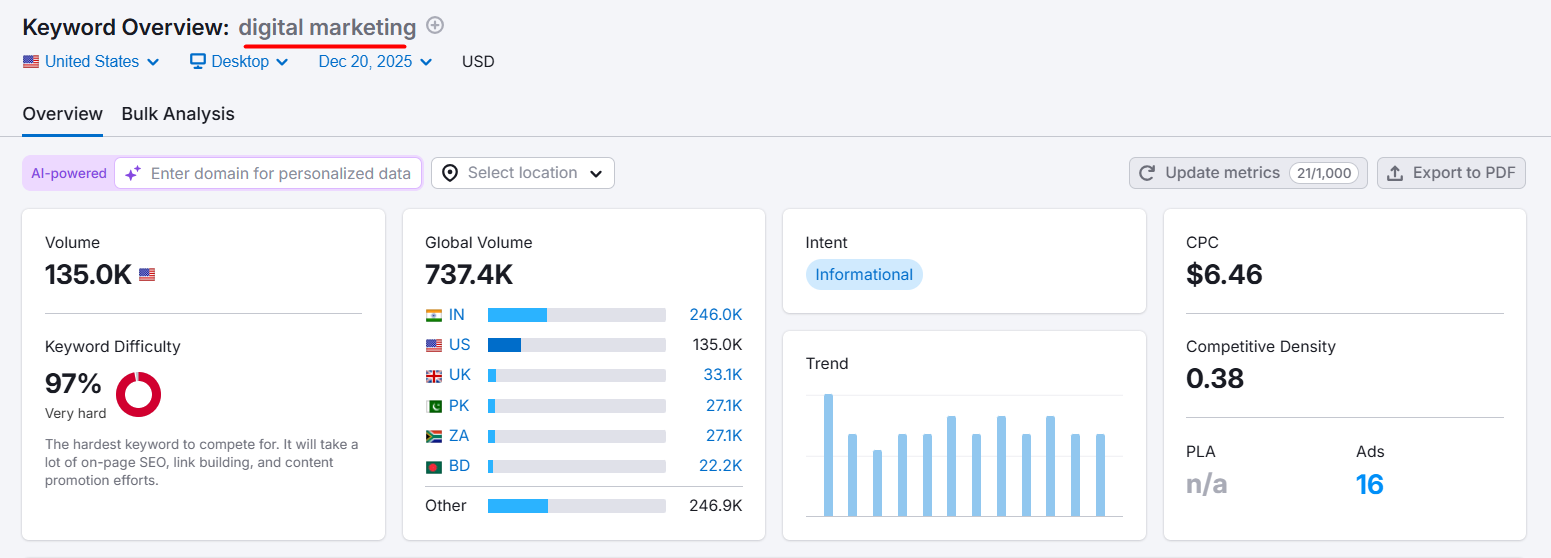
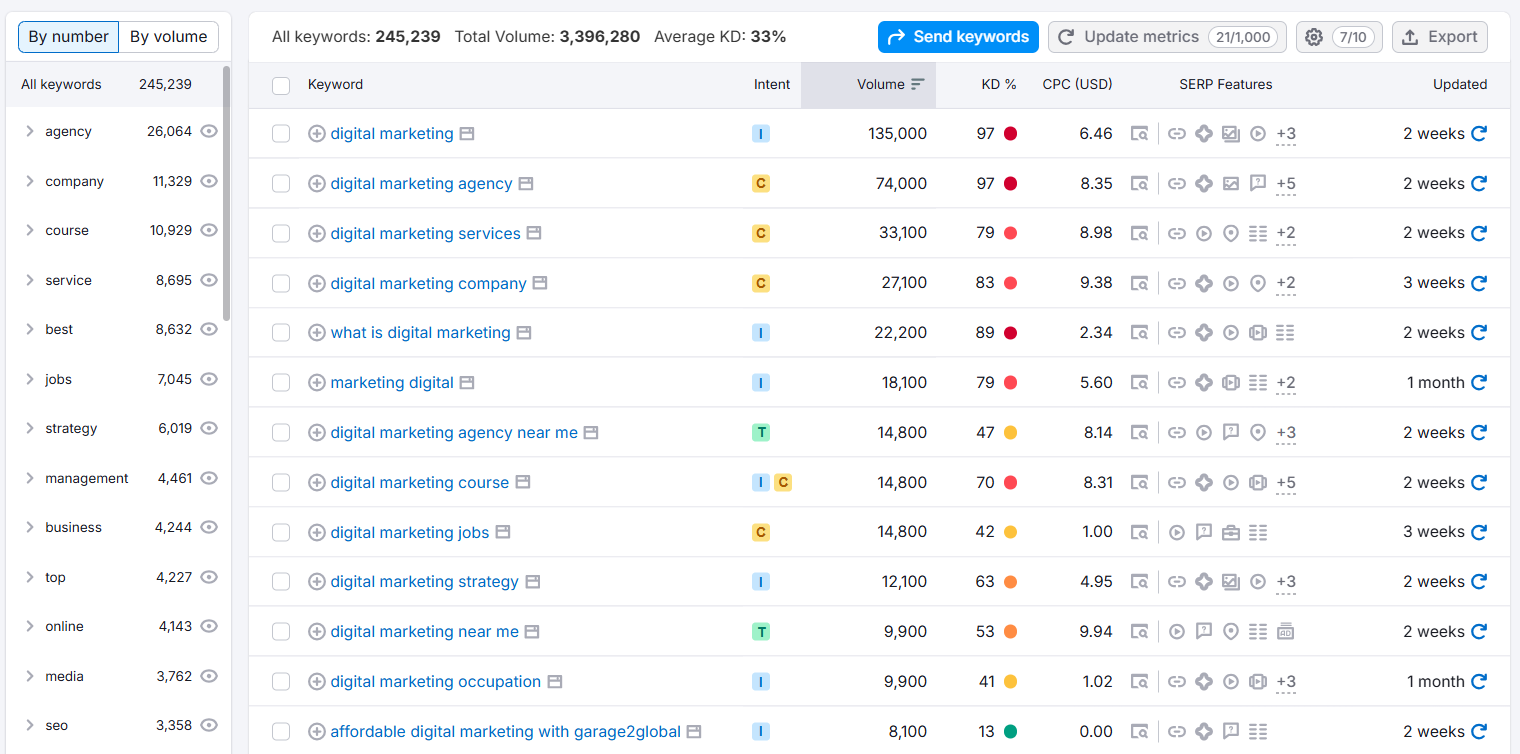
So, you may get traffic for them. But their intent is unclear because it may be informational, commercial, or transactional. For this reason, you won’t convert with them, especially in the AI-driven era. And that’s exactly why you need to focus on long-tail keywords in 2026.
To be more precise, you need to look for keywords, such as the following:
- Best AI SEO tools for SaaS startups.
- Best trail running shoes for flat feet 2026.
- Local SEO checklist for service businesses.
- SEO tools that support AI Overviews.
Hint: Use tools to find such conversational and problem‑based long-tail keywords.
As you can see, these keywords are highly specific. So, they have a clear intent, which is to solve problems.
Plus, they will have a lower search volume, which means they will be easier to rank for. So, build content around such keywords because AI overviews are more likely to cite them.
8) Failing to Use Structured Data (Schema)
As we’ve already stated above, structured data is one of the primary sources AI uses to extract content. This means that schema aids AI in understanding and showcasing material. Not only that, but structured data assists search engines in achieving the same goal while also establishing a trusting connection. Let’s use an example to better understand this.
Suppose that you have created a recipe blog post, but you haven’t added a recipe schema. In that case, the search engine will showcase your competitor’s content in the featured snippet or AI overview section. And this way, your competitor will get higher visibility in AI summaries and SERPs.
However, if you want to enjoy the same benefits for your platform, you need to do the following:
- Add schema for articles, FAQs, how-tos, products, and reviews.
- Implement JSON-LD schema for relevant content.
- Test using Google‘s Rich Results tool.
- And don’t forget to update your schema as your content evolves.
9) Neglecting Local SEO in an AI-Driven Search Environment
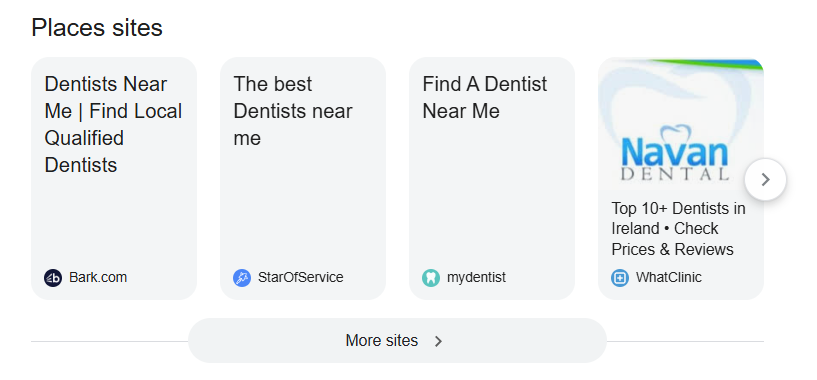
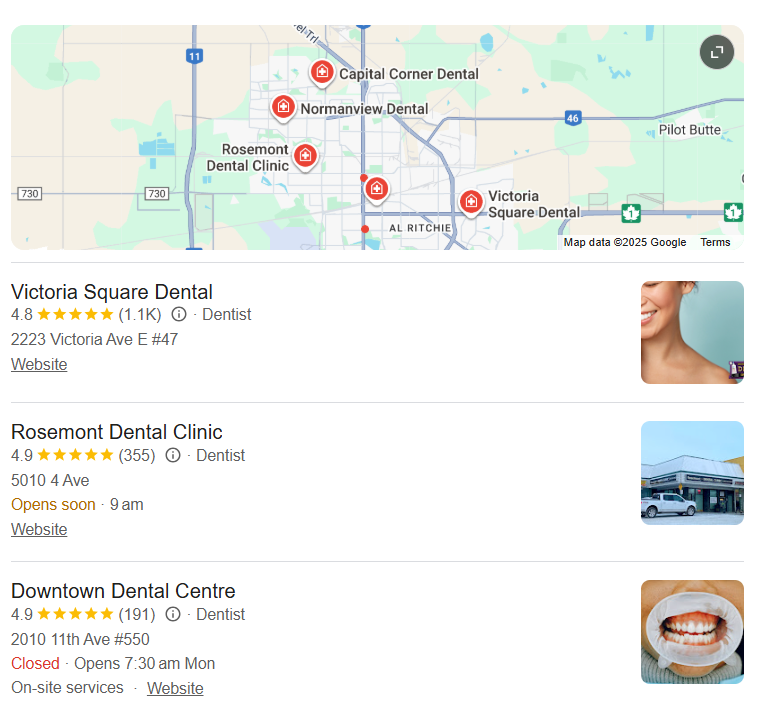
Nowadays, you may have seen that AI overviews also display results for local search queries, such as the following:
- The best dentist near me.
- Best Italian food near me.
This means that AI also extracts content from GBP (Google Business Profile), local schema, and reviews. So, if you totally ignore local SEO in this AI-dominated era, your competitors will dominate voice search queries, and you won’t get any local visibility.
However, if you want to dominate local AI recommendations, you will have to take the following actions:
- Add local schema and location pages.
- Encourage reviews.
- Keep the Number, Address, and Phone Number (NAP) consistent.
- Optimize Google Business Profile.
This way, you will target high-intent traffic, which often comes from voice search and AI queries.
Concluding Remarks — Final Words!
The biggest SEO mistake in 2026 is the lack of adaptability and strategic planning. For example, if you refuse to change, neglect AI-driven search optimization, and create material that no one—neither people nor algorithms—trusts, artificial intelligence will definitely replace you. But if you avoid these blunders, you will undoubtedly flourish in this AI era. So, read the blog article above to see how all of the aforementioned mistakes in SEO affect your site and content, as well as what steps you can take to prevent them. And remember, SEO in 2026 is more than just a checklist—it demands continuous effort. So, you can’t just do it once and then forget about it.
Alan Mike is a seasoned website content writer specializing in SEO-friendly, engaging content. With expertise in various industries, Mike creates clear, informative, and compelling copy to boost user engagement and drive organic traffic for clients.
