
- Guide
- No Comment
10 Real-Life Uses of Reverse Image Search for Smarter Online Discovery

Reverse image search, as the name suggests, is a smarter way to discover the depths of the web. That’s because instead of a textual query, you use a picture as your search query here.
But this is just the tip of the iceberg, as its applications are beyond finding similar photos. And if you want to discover those, you’ll have to stick here till the end.
In this blog post, we’ll share a detailed list of 10 real-life uses of reverse image search. So, without wasting any time, let’s get to the elephant in the room!
Uses of Reverse Image Search
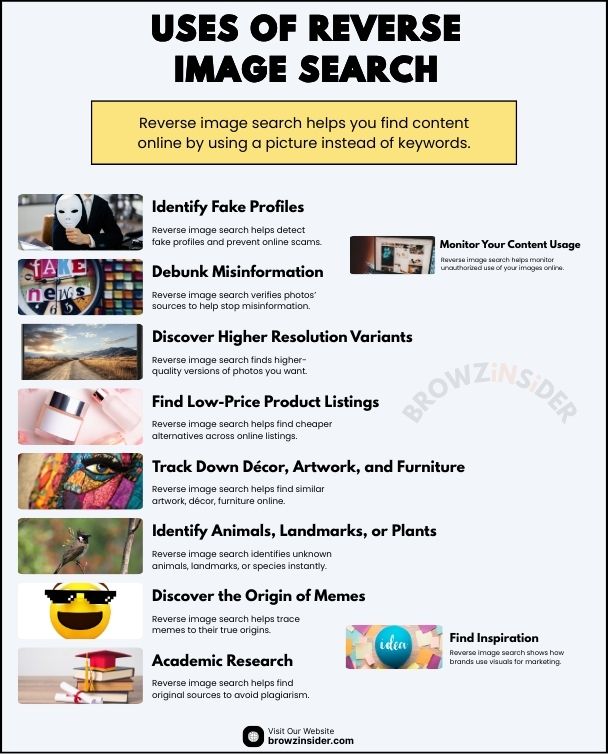
1) Identify Fake Profiles
This is the age of artificial intelligence and social media. And in these times, many people have been getting scammed online, mainly through fake profiles. But that’s where the assistance of reverse photo search can save the day.
With this technique, you can easily find out whether a social profile is fake or not. You just need to upload the profile picture to a Image search tool and wait for the results. If the output shows that others have also been using the same picture, it means the profile is fake.
2) Debunk Misinformation
These days, photo-based news and viral images spread like wildfire. That’s mainly because people share them without even checking their legitimacy. Fortunately, that’s another area where reverse image search saves the day.
This technology allows you to quickly search with a photo. Right? So, you can use it to find the original source of a picture, which will eventually help verify whether a particular piece of information is true or not.
3) Discover Higher Resolution Variants
How often does this happen to you—you find a wallpaper-worthy image, but you can’t use it because of its low quality. A lot, isn’t that right? Well, we don’t know about you, but that was a common occurrence for us before we discovered the magic of reverse picture search.
Now, if a similar situation comes up, we just conduct a picture search. Within a few seconds, we get a list of similar instances. Some would make excellent wallpaper, while others are simply unusable!
4) Find Low-Price Product Listings
You can’t negotiate while purchasing online, right? However, you can discover other vendors that sell the same product at a lower price. This is only possible due to the magic of reverse photo search.
This innovative internet discovery approach enables you to easily find visually similar versions of anything. So, you can easily locate all the e-commerce listings of a product, which will ultimately reveal the low-budget variations.
5) Track Down Décor, Artwork, and Furniture
Imagine a situation where you come across fashionable artwork, furniture, or décor in a movie or image. And now you want it, too. But you’re not sure how to explain it or where to locate it. That’s when reverse image search comes in useful.
Using this clever searching method, you can quickly find artists, galleries, or locations that feature your preferred artwork, furniture, or décor. And that is how you can make the same purchase as well.
6) Identify Animals, Landmarks, or Plants
Sometimes, you find yourself in situations when you see an unknown animal, landmark, or species. But you can’t discover any information about it. Well, that’s another area where reverse picture search can benefit you.
With this strategy, you can demonstrate that you are the smartest person in the room. All you need to do is upload a photograph of the animal, landmark, or species to an image search engine and wait for the results. The tool will efficiently locate all websites that include even the smallest facts about your uploaded picture.
7) Discover the Origin of Memes
You may have seen memes at some point, regardless of your social media profile’s algorithm. But have you ever pondered where a certain meme came from? If not, you can get assistance from reverse photo search.
How? Just use a picture search engine to examine a meme’s visual form. The tool will look for every similar occurrence of your meme in a matter of seconds. And you can investigate each source separately to determine its actual origin.
8) Academic Research
If you work in academics, you may be required to incorporate charts, diagrams, or infographics into your content. But you understand better than anybody else that you cannot simply use someone else’s stuff. Right? You must credit them. And for that, you need to locate the original source first. This is when reverse image search comes in useful.
Using this technique, you can easily discover the original source of anything available in picture form. Simply upload the photograph to an engine and start the process. Within a few seconds, you’ll receive a list of findings that you can investigate further to avoid plagiarism.
9) Monitor Your Content Usage
Let’s say that you are an artist, photographer, or belong to a company that represents one. And you routinely share your own work on your website or social media. But you’re constantly concerned about the uncredited use of your creation. If that’s the case, using the reverse picture search can help.
With this method, you can monitor the internet usage of your images. Simply upload your photograph to any search engine to begin the process. The tool will need a few seconds to perform the task. And ultimately, you’ll discover whether someone is exploiting your work without your consent or not.
10) Find Inspiration
In today’s marketing initiatives, eye-catching visuals are essential. So, if you run a brand and are unsure how a specific image will match your use case, you can take assistance from reverse photo search.
By performing a picture search on a certain visual, you can discover how other firms have used it to support their campaigns. Doing so will get your creative juices flowing, which will ultimately benefit your brand.
Concluding Remarks
To sum things up, it won’t be wrong to claim that reverse image search has nowadays become a powerful ally for netizens, professionals, researchers, and shoppers. Whether it’s verifying the authenticity of a product, protecting your creative work, simply satisfying curiosity about a landmark or recipe, or uncovering the origins of a viral meme, this technology opens doors to smarter and safer online discovery. But using this strategy is not all about finding where a photograph originally came from—it’s about unlocking context, opportunity, and truth hidden behind every pixel. So, if you want to surf the online space with sharper eyes and smarter clicks, use it wisely!
Alan Mike is a seasoned website content writer specializing in SEO-friendly, engaging content. With expertise in various industries, Mike creates clear, informative, and compelling copy to boost user engagement and drive organic traffic for clients.
